Issue #10 — The Brain Is The Next Platform (But Are ND Founders Ready?)
🎯 TL;DR
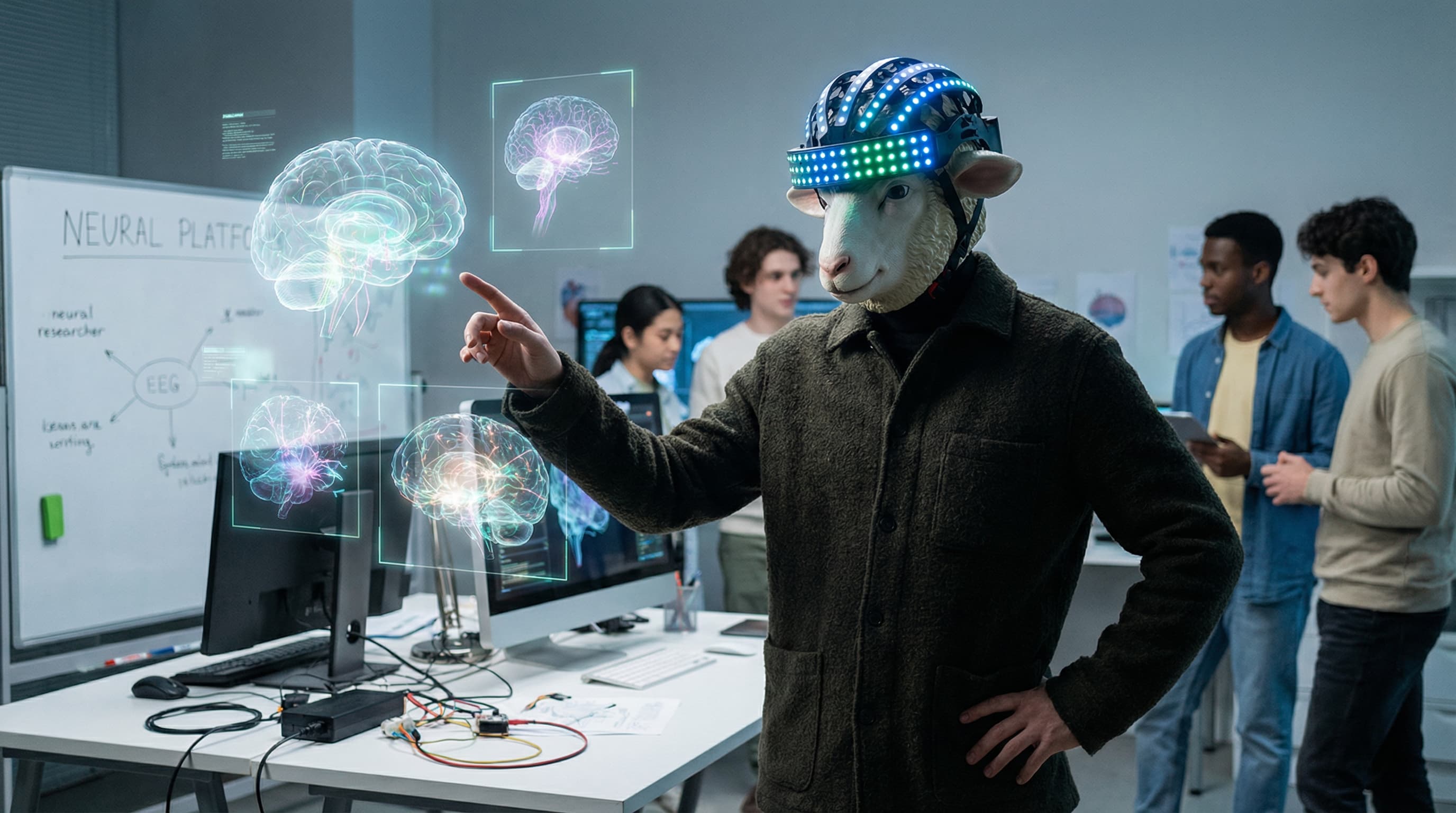
Forbes Business Council just declared "The Brain Is The Next Platform" — mining companies are evaluating EEG headsets to measure cognitive load in real-time.
This week: What brain-computer interfaces mean for neurodivergent founders, why "cognitive optimization" could be a superpower or a trap, and how to prepare for a future where your brainwaves might be part of your productivity stack.
Read time: 6 minutes
🧠 The News: Forbes Says Your Brain Is The Next Platform
A March 23, 2026 Forbes Business Council article dropped a provocative claim: executives should treat the brain like any other business platform — measurable, optimizable, and integral to competitive advantage.
The signal: Mining companies are actively evaluating EEG headsets to monitor worker cognitive load. Not for safety. Not for compliance. For productivity optimization.
"The neurally divergent will disproportionately shape America's future."
— Alex Karp, Palantir CEO (also March 2026)
Two major voices, one week, same message: Neurodivergent brains aren't something to accommodate. They're something to leverage.
🔬 What's Actually Happening
The Technology (Right Now)
EEG (electroencephalography) headsets have existed for decades. What's new:
| Then (2010s) | Now (2026) |
|---|---|
| $5,000+ research equipment | $300-800 consumer devices |
| Lab-only, gel electrodes | Dry electrodes, wearable all day |
| 5-minute setup | Instant pairing with your phone |
| Raw data dumps | AI-interpreted "focus scores" |
| Neuroscience labs | Mining sites, offices, gyms |
Companies like:
- NeuroSky — Consumer EEG for meditation/focus training
- Muse — Meditation headband with real-time feedback
- NextMind (acquired by Snap) — Direct neural interface for VR/AR
- Kernel — $100M+ funded, building "cognitive health" platforms
The Use Cases Being Tested
- Safety monitoring — Detect fatigue before accidents (mining, trucking, aviation)
- Productivity optimization — Identify peak focus windows, schedule deep work accordingly
- Training acceleration — Real-time feedback when learning new skills
- Meeting effectiveness — Measure engagement, cognitive load during collaboration
The Forbes angle: Executives who understand their brain's "platform specs" will outperform those who don't.
🦄 Why This Matters for Neurodivergent Founders
The Opportunity
ND founders already do this intuitively:
- You know your focus windows (hyperfocus isn't a bug, it's a feature)
- You've built workarounds for executive function gaps (calendar systems, body doubling, AI exobrains)
- You understand your brain has different specs than neurotypical colleagues
Brain-computer interfaces could:
- Validate your lived experience with data ("See, my brain does work differently")
- Help optimize around ND patterns (schedule client calls when social battery is full, deep work during hyperfocus windows)
- Provide early warning for burnout (cognitive load trends before you crash)
The Risk
"Cognitive optimization" can become another form of masking:
| Healthy Use | Problematic Use |
|---|---|
| "My EEG shows I focus best 9-11 AM" | "My CEO expects 8 hours of 'green zone' focus daily" |
| "I need a break, my cognitive load is critical" | "Breaks are for people whose brains can't handle the load" |
| "This tool helps me understand my energy patterns" | "This tool proves my brain is defective" |
The neurodiversity movement fought hard against "fixing" ND brains. Brain-computer interfaces could either:
- ✅ Amplify ND advantages (data-driven self-advocacy)
- ❌ Pathologize ND patterns (metrics that define "normal" productivity)
📊 The Market Signal
This isn't just Forbes think-piece territory. Money is moving:
| Sector | Investment | Timeline |
|---|---|---|
| Digital mental health | $5.6B (2024) → $54.2B (2035) | 10x growth |
| Neurodivergent hiring platforms | £250K rounds active | Now |
| University ND talent programs | Major institutional funding | Now |
| Consumer EEG devices | Growing steadily | 2-3 years to mainstream |
Palantir's Alex Karp (himself neurodivergent) explicitly tied ND talent to AI-era competitiveness. Forbes Business Council is telling executives to treat brains as platforms.
Translation: The conversation is shifting from "accommodate ND people" to "ND brains are competitive advantages."
🛠️ What To Do With This Information
Short-Term (This Quarter)
Don't rush out and buy an EEG headset. But do this:
- Track your own cognitive patterns — Use simple tools (calendar blocking, energy logs, focus apps) to map your brain's "platform specs"
- Identify your hyperfocus triggers — What conditions unlock your best work? (time of day, environment, task type)
- Build systems around your brain — Not against it. If you crash at 3 PM daily, don't schedule client calls then.
Medium-Term (6-12 Months)
Watch these developments:
- Enterprise adoption — Are companies requiring cognitive monitoring? (red flag)
- ND-focused tools — Are brain-computer interfaces being designed with ND input, or for ND "fixing"? (big difference)
- Privacy regulations — Who owns your brainwave data? Can your employer access it?
Long-Term (2-5 Years)
Position yourself:
- If you're building ND-focused tools: How could biometric feedback enhance your product?
- If you're a consultant/coach: Could cognitive data help clients advocate for better workflows?
- If you're a founder: What's your stance on cognitive monitoring in your company?
🎯 The Divergent Take
Here's what mainstream coverage misses:
Neurodivergent founders didn't wait for EEG headsets to understand their brains. We've been hacking our own cognitive platforms for years.
- Calendar systems = external executive function
- Body doubling = social scaffolding for task initiation
- AI exobrains = cognitive offloading for working memory gaps
- Energy mapping = manual cognitive load tracking
The question isn't "Should ND founders use brain-computer interfaces?"
The question is: "Who gets to define what 'optimized' looks like?"
If it's neurotypical executives measuring ND brains against neurotypical standards — that's the old game.
If it's ND founders using data to amplify our natural advantages — that's the future we should build.
📚 Resources & Further Reading
- Forbes: "The Brain Is The Next Platform" — Link
- Business Insider: Alex Karp on neurodivergent talent in AI era — Link
- Inc Magazine: "Beyond ADHD: The AuDHD Breakthrough" — Link
💬 Discussion Prompt
What's your stance on cognitive monitoring?
- Would you wear an EEG headset to optimize your workday?
- What would make it feel empowering vs. surveillant?
- What metrics would actually be useful for your brain?
Reply to this email or hit me up on Twitter [@yourhandle]. I'm genuinely curious where the line is for you.
Next week: We're diving into the "neurodiversity backlash" narrative and why it's actually a sign of progress. (Spoiler: When marginalized groups gain visibility, backlash is inevitable — and it means you're winning.)
See you Tuesday,
L-P
P.S. — If you found this useful, forward it to one ND founder who'd appreciate it. Divergent grows by word-of-mouth, not algorithms.